Does Teeth Whitening Damage Enamel?

Updated: 7 days ago

Quick Answer
No. The clinical evidence does not show that professional teeth whitening damages healthy enamel when it is done correctly.
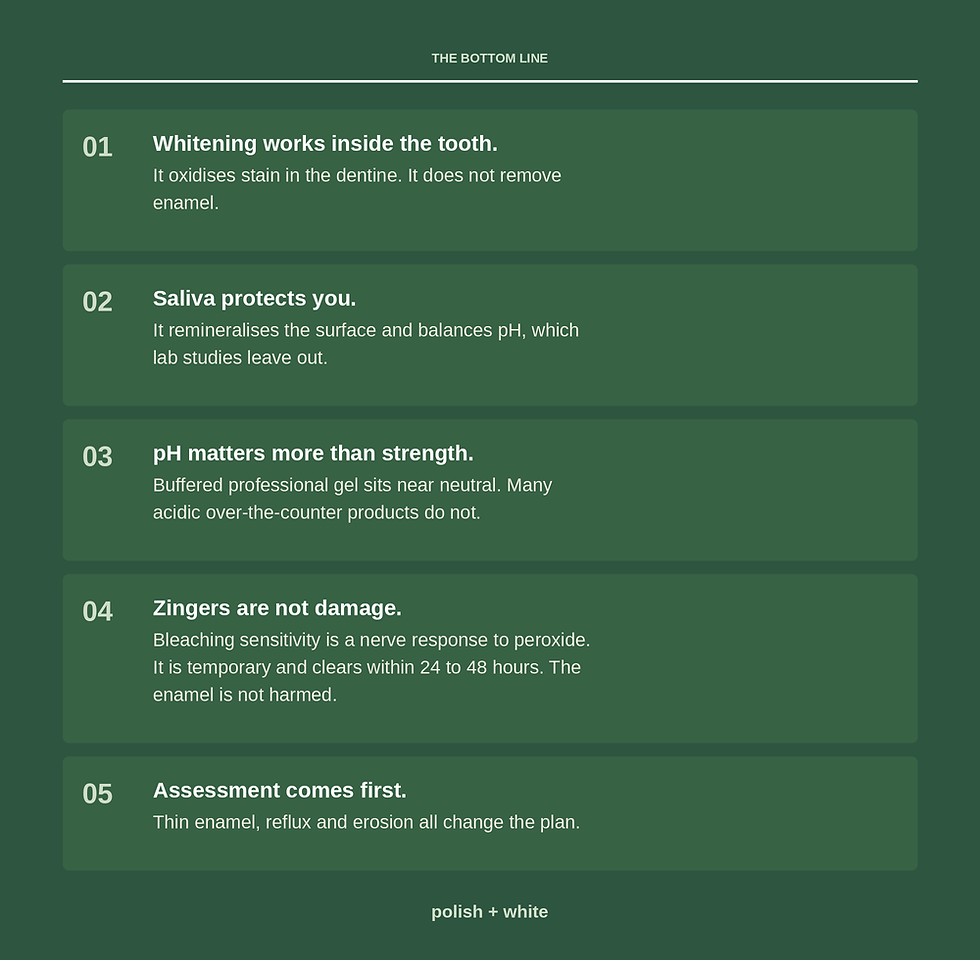
Whitening works by oxidising stain molecules inside the tooth. It does not strip enamel away.
Most of the worry comes from lab studies that leave out saliva. In your mouth, saliva helps the enamel recover and keeps the pH balanced.
The bigger risk sits with some over-the-counter products and DIY trends. These are often more acidic, and acid is what harms enamel.
Sensitivity is common and temporary. It is not the same thing as damage.
Written by Marnie St George, registered dental hygienist. I use AI to help draft, then question and check the content using my dental hygiene training and experience. I'm only human, so unintended mistakes are possible
Does Teeth Whitening damage enamel ? - Where the Fear Comes From
This is one of the questions I hear most often. Someone wants whiter teeth, but they have read that whitening wrecks your enamel, so they hold off.
The fear is understandable. It usually comes from a few places. People feel sensitivity after whitening and assume their enamel has been harmed. The words bleach and hydrogen peroxide sound frightening. Social media is full of dramatic stories with no clinical context. And some DIY trends, like charcoal scrubs and acidic home remedies, genuinely do harm teeth, so people assume professional whitening must do the same.
None of these are the full picture. Here is what the evidence shows.
What Whitening Does to a Tooth
The gel changes the colour inside the tooth. It does not remove the enamel.
Your teeth are built in layers. The outer layer is enamel, which is hard and translucent. Under it sits dentine, which is softer and more yellow. Most of the colour you see is the dentine showing through the enamel.
When whitening gel goes on, the hydrogen peroxide passes through the enamel and reaches the stain molecules in the dentine. It breaks those molecules down so they reflect light differently. That is what makes the tooth look brighter. The enamel itself stays in place. This is the same process I covered in my Blog - Is Professional Teeth Whitening Safe?

What the Clinical Evidence Shows
Most of the scary findings about enamel come from in vitro studies. That means teeth sitting in a dish in a lab, not teeth in a living mouth. This matters more than it sounds.
A 2026 systematic review and meta-analysis in the Journal of Dentistry (Márton et al.) pooled data from 81 in vitro studies. It found a small, statistically detectable reduction in enamel micro hardness after peroxide whitening. The authors were careful about what that means clinically. The results varied between studies and were influenced by a small number of unusual results. Their conclusion was that the available evidence does not support consistent or substantial enamel softening from peroxide-based bleaching — though they noted that clinical relevance remains uncertain and that better standardised research is still needed.
The reason the lab and the mouth give different answers is saliva.

What Saliva Does
Saliva is not only water. It carries calcium and phosphate, the same minerals enamel is built from. After whitening, saliva helps the enamel surface remineralise and brings the pH back to normal. Research has long noted that mineral loss during bleaching is offset by the remineralising action of saliva.
I want to be honest about the limits here. Some lab studies suggest that with strongly acidic gels, a few days of saliva is not enough to fully restore the surface. That is one more reason the type of gel matters so much, which I will come to next. The clinical picture overall does not show lasting enamel damage from well-formulated professional whitening, but the gel chemistry is doing a lot of the work.
Why the Gel Chemistry Matters
The single most important factor is pH, not the peroxide percentage.
Enamel starts to soften below a pH of about 5.5. So the question that matters is not how strong the gel is. It is how acidic it is. Acid damages enamel. Hydrogen peroxide, when buffered correctly, does not

This is where professional and over-the-counter products part ways. A buffered professional gel is mixed to bring the pH close to neutral, so it is far gentler on enamel. Many over-the-counter products are made more acidic on purpose. The low pH helps the product stay stable on a shop shelf for months without refrigeration. This shelf-life trade-off is well documented in the dental literature.
I keep my professional gel refrigerated, so it does not need that acidic stabiliser to survive storage. A product sitting on a warm pharmacy shelf does. That is a real difference in how kind the product is to your teeth, and it has nothing to do with how strong it looks on the label.
A Note on Whitening Toothpaste
Whitening toothpastes are worth a separate mention. Most contain such a small amount of hydrogen peroxide that it does not sit on the tooth long enough to whiten anything. Saliva dilutes it further. What these toothpastes mostly do is use mild abrasives to scrub surface stain off. That makes teeth look brighter in some cases, but it is stain removal, not whitening.
Used every day, the more abrasive ones are a long-term concern for me. If you want to keep surface stains at bay without the abrasion, my favourite is Sensodyne Complete Care + Smart Clean for daily use, and a good match for whitening treatment. It contains 5% potassium nitrate, which works over time to calm the nerve and reduce sensitivity sometimes experienced during teeth whitening. The fluoride is sodium fluoride at 1426ppm, which supports enamel remineralisation without the staining risk that stannous fluoride carries. It is also low abrasion because it contains sodium tripolyphosphate which lifts surface stain chemically rather than scrubbing it off mechanically, which is far gentler on enamel with daily use.
So Why Do Some DIY Trends Cause Harm?
This is the heart of the confusion. People see real damage from a viral whitening trend and assume all whitening does the same.
Charcoal scrubs work by being abrasive. They scratch the surface. Acidic home remedies like lemon juice or vinegar sit well below that pH 5.5 threshold and soften enamel directly. Over-the-counter strips used too often, left on too long, or used by people they were never designed for are also a source of problems, partly because there is no clinician adjusting anything and no gum protection.
One concern I see regularly is younger people getting access to over-the-counter strips. In New Zealand, high-concentration whitening products are restricted for under 16s for good reason — the pulp chamber is larger in younger teeth, which means peroxide reaches the nerve more easily. But lower-concentration strips are widely available, and products kept at home are not always out of reach.
Across all ages, the bigger issue is overuse. Most people do not follow the manufacturer's instructions. Strips get used more often than directed, left on longer than recommended, and repeated well beyond the suggested cycle. With a product that could already be more acidic than a professional gel, that kind of overuse puts enamel at real risk over time.
The damage in these cases is real. But the cause is abrasion, acid, or misuse. It is not the controlled, buffered, supervised process of professional whitening.
When I Am More Cautious
Professional whitening is safe for healthy enamel. But not every mouth starts from the same place, and a proper assessment matters. These are the situations where I take extra care.
Thin enamel.
When enamel is thin, the yellow dentine shows through more, so teeth often appear more yellow to begin with. Thin enamel also lets peroxide reach the nerve faster, which means more sensitivity. I often place a fine barrier over the thinnest areas so the gel does not travel straight to the nerve.
A history of acid reflux.
Reflux exposes teeth to stomach acid, which may already have worn the enamel. I assess this carefully before deciding how much whitening is appropriate.
Exposed dentine or roots.
Exposed dentine and root surfaces do not whiten. I cover these areas with a gingival barrier so the gel does not reach them and cause sensitivity.
Restorations on front teeth.
Crowns, veneers, bonding and fillings do not change colour. We lift surface stain only — they will not whiten. A shade mismatch needs to be discussed before we start.
Sensitivity from Zingers Is Not Damage
This is the point I want to clearly explain - Sensitivity comes in many forms and is not caused by one thing.
To understand why, it helps to know that there are three distinct types of dental sensitivity — and whitening is only directly responsible for one of them.
The first is bleaching sensitivity which is temporary. This is the type people experience during or after a whitening treatment. Peroxide passes through the enamel and reaches the pulp, where it activates nerve fibres inside the tooth. Research suggests this involves TRPA1 channels — pain receptors in the pulp that respond to the peroxide. The result is a sharp, short sensation often described as a zinger. It has no external trigger. It does not mean the tooth is damaged. It means the nerve is responding to a chemical stimulus, and once the peroxide clears, the sensation goes with it. Most studies report it settles within 24 to 48 hours. If sensitivity lasts beyond a few days or feels different from a typical zinger, get it checked. This is usually a sign of a pre-existing condition, not the whitening itself.
The second is dentine hypersensitivity. This is triggered by something external — cold, heat, or touch — and comes from exposed dentine tubules caused by gum recession or enamel loss. This type exists independently of whitening. Whitening can aggravate it temporarily, which is one reason a clinical assessment matters before treatment begins.
The third is sensitivity from compromised teeth — decay, cracks, or structural damage. This type often shows up as a response to sweet foods or drinks. It is a sign the tooth needs attention, not whitening.
Understanding which type a person is experiencing changes what I do next. Bleaching sensitivity is managed by adjusting gel strength, shortening contact time, or applying a desensitising agent. Dentine hypersensitivity is addressed before treatment begins, often using a gingival barrier to cover exposed root surfaces . Compromised teeth are referred to dentist before whitening is considered at all.
The enamel is not harmed in the process of bleaching sensitivity. What you feel is a nerve response, not structural damage. Read Blog 4 and I will explain - Why teeth feel sensitive after whitening ?
.
What I Want You to Take Away
Two things change everything about how safe whitening is for your enamel. The gel chemistry, and the person delivering it.
Because I allow plenty of time for each appointment, I can start at a sensible strength and adjust as we go. If you feel sensitivity, I can pause, give your teeth a rest, drop to a lower strength, and change the plan in real time. That flexibility is the difference between a supervised treatment and a one-size-fits-all kit.
Everyone is individual.To get a sense of what whitening looks like in practice, take a look at the results. I cannot promise an exact shade or guarantee you will feel nothing. The evidence is clear, though: done properly, professional whitening does not damage healthy enamel. Read more about professional teeth whitening on my Home page
Frequently Asked Questions
Does teeth whitening damage enamel?
No. The clinical evidence does not support consistent or substantial enamel damage from professional whitening used correctly.
What are zingers?
Zingers are sharp, short sensations caused by peroxide reaching the nerve. They are temporary and not a sign of damage.
Why does pH matter in whitening gel?
Enamel softens below pH 5.5. Buffered professional gel sits near neutral. Many over-the-counter products are more acidic, which carries more risk for enamel.
Is sensitivity the same as enamel damage?
No. Sensitivity is a temporary nerve response. The enamel is not harmed in the process.
Are over-the-counter strips safe?
Used correctly and not too often, low-concentration strips carry low risk for most adults. The concern is overuse, incorrect use, and use by under 16s.
Read more FAQ’s HERE
Not sure if whitening suits your enamel?
Every treatment at Polish + White in Epsom begins with a clinical assessment by Marnie St George, registered dental hygienist, so your enamel and your teeth are checked before anything starts.
Clinical References
Chen C, Huang X, Zhu W, Ding C, Huang P, Li R. TRPA1 triggers hyperalgesia and inflammation after tooth bleaching. Scientific Reports. 2021;11:17418. DOI: 10.1038/s41598-021-97040-w
Márton P, Antal M, Kiss-Dala Sz, Agócs G, Qian X, Hegyi P, Varga G, Ábrám E. Enamel Damage from Tooth-Whitening: A Systematic Review and Meta-analysis. Journal of Dentistry. 2026;172:106786.
Butera A, Maiorani C, Rederiene G, et al. Evaluation of the Effectiveness of Different Types of Professional Tooth Whitening: A Systematic Review. Bioengineering. 2024;11(12):1178.
Eisenburger M, Addy M, Hughes JA, Shellis RP. Effect of time on the remineralisation of enamel by synthetic saliva after citric acid erosion. Caries Research. 2001;35(3):211–215.
A Radical-Free Approach to Teeth Whitening. (Low pH common in commercial HP products to extend shelf life; acidic, low-calcium gels worsen enamel mineral loss.) PMC8700120.
American Dental Association. Oral Health Topics: Whitening (Tooth Bleaching).
New Zealand EPA. Cosmetic Products Group Standard — hydrogen peroxide concentration limits.
Dental Council of New Zealand. Advertising Practice Standard. 1 September 2020.


Comments